Costly Employment Mistakes Alberta Employers Should Avoid
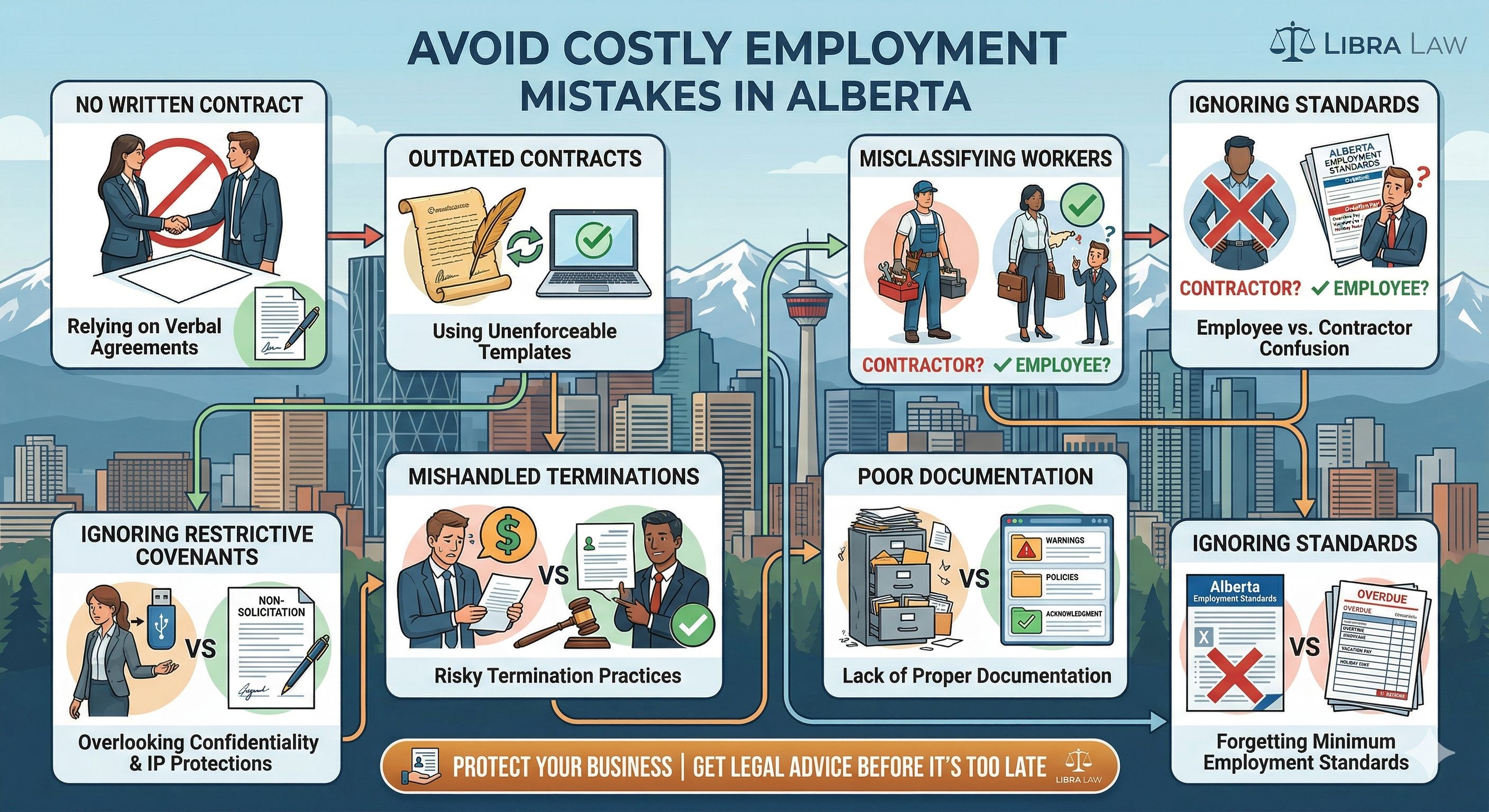
For many Alberta business owners, employment law problems do not start with a major dispute. They often begin with small decisions that seem harmless at the time—hiring someone without a proper contract, calling a worker an independent contractor without understanding the legal test, or handling a termination too casually.
Those mistakes can become expensive very quickly.
If you own or operate a business in Alberta, understanding common employment law risks is essential. The right contracts, policies, and legal guidance can help you avoid disputes, reduce liability, and protect your business as it grows.
Why employment mistakes are so costly for Alberta businesses
Employment issues can affect multiple parts of your business at once. A poorly drafted employment agreement can create confusion around compensation, duties, termination rights, confidentiality, or workplace expectations. A worker classification mistake can impact overtime, vacation pay, payroll obligations, and termination exposure. A rushed dismissal can turn a straightforward staffing decision into a much larger legal problem.
That is why prevention matters. A proactive legal review of your hiring documents, workplace practices, and termination procedures is usually far less expensive than dealing with a dispute after the fact.
If your business has not reviewed its contracts recently, a good place to start is this article on employment contracts in Alberta and the clauses that protect employers.
1. Hiring employees without a written employment contract
One of the most common employment mistakes Alberta employers make is relying on verbal agreements or short offer letters that do not properly define the employment relationship.
A written employment contract can help clarify key terms such as:
- job duties
- compensation
- bonus eligibility
- probation terms
- vacation entitlements
- confidentiality obligations
- termination process and termination pay
- non-solicitation and other restrictive clauses where appropriate
Without a properly drafted agreement, misunderstandings become much more likely. Even if the relationship starts off smoothly, problems often surface later when there is a compensation disagreement, a performance issue, or a termination.
To learn more, read why written contracts for small business in Alberta matter and explore Libra Law’s Alberta employment law services.
2. Using outdated or unenforceable employment contract templates
Many Alberta employers make the mistake of using employment contracts copied from the internet, borrowed from another company, or drafted years ago without any updates.
That approach creates risk.
A contract is not automatically enforceable simply because it is in writing. If the language is unclear, overly broad, inconsistent, or poorly drafted, it may fail to provide the protection the employer expected or can make the entire contract void. This is especially important when it comes to termination language, restrictive covenants, and other clauses meant to reduce risk.
Employers should also be cautious about updating contracts after employment has already started. Timing and proper legal structure matter.
For more on this issue, see whether post-hire employment contracts are enforceable in Alberta.
3. Misclassifying workers as independent contractors
Another major employment law mistake in Alberta is assuming that calling someone a contractor automatically makes them one.
It does not.
If a worker is treated as an independent contractor but should legally be classified as an employee, the business may face disputes involving:
- overtime pay
- vacation pay
- holiday pay
- termination obligations
- payroll deductions
- workplace protections
This issue often arises when businesses grow quickly and bring people on informally without properly reviewing the structure of the relationship.
If you want to understand this risk in more detail, read employee vs. contractor misclassification in Alberta.
4. Ignoring minimum employment standards in Alberta
Some employers focus only on what they agreed to privately with the employee and forget that Alberta employment law sets minimum standards that generally cannot be contracted out of.
That can lead to serious compliance issues.
Common mistakes include:
- failing to track hours properly
- misunderstanding overtime obligations
- paying vacation incorrectly
- making improper deductions
- mishandling termination pay or notice
- overlooking employee leave entitlements
Even employers with good intentions can make mistakes when they rely on assumptions instead of current legal guidance.
If your business is expanding, this is a good time to review your hiring, payroll, and termination practices with a lawyer.
5. Waiting too long to put proper terms in place
Timing matters when it comes to employment contracts.
Many employers only think about stronger legal protection after a problem appears—such as a performance concern, a promotion, a compensation dispute, or an anticipated termination. By that point, it may be much more difficult to introduce any new terms in a clean and enforceable way.
That is why employers should ideally have properly drafted contracts in place before the employee starts work.
This is especially important if you want to include clear clauses dealing with termination, confidentiality, intellectual property, and restrictive covenants.
A strong starting point is this guide to employment contract clauses that protect employers in Alberta.
6. Poor documentation of workplace issues
A surprising number of employment disputes become harder to manage because the employer did not document workplace issues clearly.
This can include:
- unclear job expectations
- no written policies or acknowledgments
- missing records of warnings or performance discussions
- inconsistent disciplinary steps
- little to no documentation supporting major decisions
Good documentation is not just about preparing for termination. It helps create clarity, consistency, and fairness throughout the employment relationship.
When expectations are communicated properly and documented early, many disputes can be avoided before they escalate.
7. Mishandling employee terminations
Terminations are one of the highest-risk moments in any employment relationship.
Many Alberta employers make the mistake of assuming termination is simple as long as they give the employee something. In reality, poorly handled terminations can create unnecessary legal exposure.
Common termination mistakes include:
- terminating without reviewing the employment contract first
- using a termination letter that creates risk
- assuming short-service employees have little or no claim
- overlooking bonus, commission, or benefits issues
- offering a package without legal review
- failing to consider whether the employee may have entitlements beyond minimum standards
Before terminating an employee, employers should carefully review:
- the signed employment contract
- the employee’s role and compensation structure
- bonus or commission exposure
- any recent changes to duties or title
- the wording of the termination letter
For related guidance, see:
- lawyer review of a termination letter in Alberta
- severance pay in Alberta
- severance packages in Alberta
- wrongful dismissal compensation in Alberta
8. Overlooking restrictive covenants and confidentiality protections
Some businesses do not think seriously about confidentiality, client relationships, or competitive risk until an employee leaves.
By then, it may be too late.
If your business depends on confidential information, trade knowledge, internal systems, pricing models, or client goodwill, your employment agreements should be reviewed to ensure the right protections are in place from the beginning.
That does not mean every employee needs the same restrictive clauses. The better approach is a role-specific agreement that reflects the actual legal and business risks.
For more on this topic, read non-compete clauses in Alberta.
9. Treating employment law as a one-time setup task
Employment law compliance is not something Alberta business owners should set up once and then ignore.
As your business changes, your documents and practices should change too. New compensation models, promotions, remote work arrangements, foreign worker hiring, acquisitions, and updated workplace policies can all affect your legal risk.
For example, employment issues often overlap with other business matters when buying a company or hiring workers through immigration pathways.
Relevant resources include:
- buying a business and employment law risks in Alberta
- buying a business that employs foreign workers
- employer-sponsored work permits in Canada
How Alberta business owners can reduce employment risk
A practical employment law risk-reduction strategy often includes:
- properly drafted written employment contracts
- clear onboarding documents
- role-specific workplace policies
- regular payroll and standards compliance checks
- worker classification review
- legal advice before major discipline or termination decisions
- contract and policy updates as the business grows
If you are not sure where your biggest vulnerabilities are, start with a legal review of your contracts and workplace documentation. In many cases, the biggest risks are hidden in documents the business has used for years without review.
You may also find this helpful: small business legal checklist for Calgary entrepreneurs.
Final thoughts
Costly employment mistakes are rarely caused by bad intentions. More often, they happen because employers move quickly, rely on generic templates, or assume their current process is good enough.
That assumption can be expensive.
If your business hires employees in Alberta, a proactive legal review of your contracts, workplace policies, and termination practices can help reduce risk before a dispute arises.
To get practical guidance tailored to your business, visit Employment Law services at Libra Law or contact Libra Law.
FAQ: Costly employment mistakes in Alberta
What is the most common employment law mistake Alberta employers make?
One of the most common mistakes is using weak, outdated, or incomplete employment contracts. Employers also frequently make mistakes involving worker classification, termination, and minimum standards compliance.
Can an Alberta employer rely on a template employment contract?
A template may help as a starting point, but it should not be relied on without legal review. A contract should reflect your business, your employees, and your specific risk areas.
Are minimum employment standards the only rules Alberta employers need to think about?
No. Minimum standards provide a base-level of protections. Employees may be entitled to more under common law. Employers should also consider contracts, policies, termination risk, documentation, and the overall legal structure of the employment relationship.
When should an Alberta employer speak to an employment lawyer?
Ideally before hiring, before updating important contracts, and before terminating an employee. Early advice is usually much less expensive than dealing with a dispute later.
This article is for general informational purposes only and does not constitute legal advice. For advice specific to your situation, consult a qualified professional.
