Minority Shareholder Protection in Alberta: Key Agreement Clauses
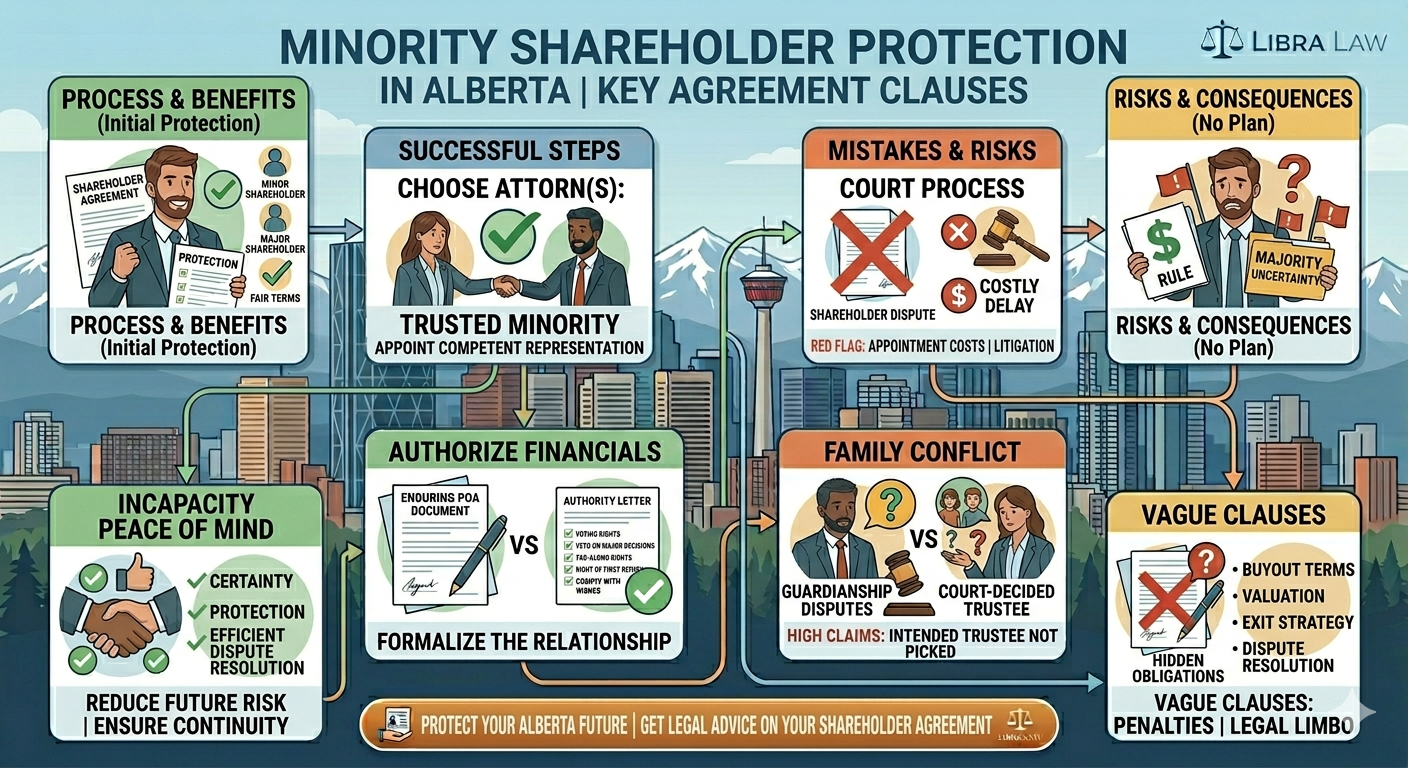
Minority shareholders often invest significant money, time, and trust into a business without having day-to-day control over how the company is run.
That can create real risk.
If you hold a minority stake in an Alberta corporation, you may have less voting power, less influence over management decisions, and less ability to stop actions that affect the value of your shares. Without proper legal protections in place, a minority shareholder can end up excluded from important decisions, diluted by new share issuances, pressured into an unfair buyout, or trapped in a dispute with no practical exit.
That is why a well-drafted shareholder agreement is so important.
For many Alberta businesses, especially closely held corporations, the shareholder agreement is one of the most effective tools for protecting minority shareholders before conflict begins.
Why minority shareholder protection matters in Alberta
Minority shareholders are often vulnerable because control usually sits with the majority.
A majority shareholder may be able to influence:
- board composition
- dividend decisions
- management compensation
- future share issuances
- business direction
- major transactions
- access to company information
Even where everyone starts with a good relationship, things can change over time. Disputes may arise because of business growth, succession planning, family conflict, outside investment, or changing financial pressure.
If a minority shareholder has no clear contractual protections, their position can become very weak in practical terms.
That is one reason Alberta business owners should not treat shareholder agreements as optional paperwork.
For broader background, read shareholder agreements in Alberta and why your business needs a shareholder agreement.
What a shareholder agreement does
A shareholder agreement sets rules for how shareholders will deal with each other and how certain business issues will be handled.
In an Alberta corporation, a properly drafted agreement can help address:
- voting rights
- share transfers
- future financing
- management authority
- dividend expectations
- dispute resolution
- buyout rights
- exit terms
- protections for minority shareholders
In some cases, businesses may also use a unanimous shareholder agreement, which Alberta corporate law specifically recognizes. A unanimous shareholder agreement can reallocate certain powers that would otherwise belong to directors and set binding rules among shareholders.
For many privately held corporations, this is where the real protection is built.
Why minority shareholders are at risk without a strong agreement
Without clear legal protections, a minority shareholder may face several common problems.
Exclusion from important decisions
A minority shareholder may invest in the corporation but still have little say in major business decisions if the majority controls voting.
Dilution of ownership
If new shares are issued without proper protection, a minority shareholder’s percentage ownership may shrink.
Unfair pressure to sell
A minority shareholder may be pushed to sell on terms they did not expect, especially if there is no clear valuation formula or buyout process.
Limited access to information
If the agreement does not address disclosure and reporting, the minority shareholder may struggle to get timely and meaningful information about the business.
Dividend or compensation imbalance
The majority may structure compensation or retained earnings in ways that reduce the practical value of the minority shareholder’s investment.
That is why the agreement should be drafted with real-world conflict in mind, not just ideal circumstances.
Key clauses that help protect minority shareholders in Alberta
1. Reserved matters and voting protections
One of the most important protections is requiring minority approval for certain major decisions.
These decisions are sometimes called reserved matters and may include:
- issuing new shares
- taking on major debt
- amending the articles
- changing share rights
- approving major asset sales
- entering into significant related-party transactions
- winding up the corporation
- changing the nature of the business
This kind of clause helps prevent the majority from making major structural decisions without at least some minority involvement.
2. Pre-emptive rights to prevent dilution
Pre-emptive rights give existing shareholders the opportunity to buy new shares before outsiders or other shareholders receive them.
This can be a critical protection for minority shareholders because it helps preserve their percentage ownership if the corporation issues new shares.
Alberta’s Business Corporations Act includes a statutory concept of shareholder pre-emptive rights, but those rights do not automatically apply in every situation and should be considered carefully in the corporate documents and shareholder agreement.
For practical business planning, it is much safer to address this issue clearly in the agreement.
3. Information and inspection rights
A minority shareholder should not be left guessing about how the business is performing.
The shareholder agreement can require the corporation to provide:
- annual financial statements
- interim financial reporting
- notice of major events
- access to certain corporate records
- budgets or forecasts in appropriate cases
Alberta corporate law includes record-keeping and access rules for corporate records, but a tailored agreement can go further in defining what shareholders will actually receive and when.
This is especially important in closely held corporations where the minority shareholder is not involved in daily management.
4. Board representation rights
In some corporations, minority protection may include the right to appoint or nominate a director.
This can help ensure the minority shareholder has visibility into major decisions and a voice at the board level, even if they do not control the company.
Board representation is not appropriate in every company, but where the minority shareholder has made a meaningful investment or strategic contribution, it can be an important protection.
For related reading, see directors’ duties and liability in Alberta and director personal liability after incorporation in Alberta.
5. Dividend policy or distribution protections
Some shareholder disputes are less about formal ownership and more about money.
A minority shareholder may technically own valuable shares but receive little practical benefit if the majority controls whether profits are distributed. In some businesses, the majority may prefer to leave profits in the corporation or pay themselves through salary, management fees, or other structures.
A shareholder agreement can help by addressing:
- when dividends may be considered
- what approval is required
- whether certain compensation practices are restricted
- how profits and distributions will be approached
This can reduce the risk of a minority shareholder being frozen out economically.
6. Restrictions on share transfers
Share transfer rules are essential in private corporations.
Minority shareholders usually want protection against:
- being forced into business with an unwanted third party
- having the majority sell control without fair treatment for the minority
- being trapped with no reasonable exit at all
A shareholder agreement can set out how shares may be sold, offered, or transferred, and under what conditions.
7. Tag-along rights
Tag-along rights are one of the clearest minority protections in a shareholder agreement.
These rights generally allow a minority shareholder to participate in a sale if the majority is selling its shares to a third party. That way, the majority cannot simply sell control and leave the minority behind under a new ownership group they did not choose.
For many minority shareholders, this is a crucial protection.
8. Buy-sell and buyout clauses
Disputes often become most difficult when one side wants out and the other side does not.
A good shareholder agreement can define:
- when a buyout may be triggered
- who can trigger it
- how notice must be given
- how the shares will be valued
- how payment will be made
- what happens if the parties disagree
Without these clauses, a minority shareholder may find it very hard to exit the business on fair terms.
9. Valuation formula or valuation process
A buyout clause is only as useful as the valuation method behind it.
The agreement should address how shares will be valued if:
- one shareholder wants to exit
- a deadlock occurs
- death, disability, or retirement affects ownership
- a default or forced sale arises
Possible valuation approaches may include:
- a fixed formula
- an agreed process using a valuator
- a hybrid process if the parties disagree
This reduces the chance of a minority shareholder being pressured into accepting an unfair price.
10. Deadlock and dispute resolution clauses
A dispute between shareholders can paralyze a business, especially when ownership is closely split.
A shareholder agreement should consider:
- mediation requirements
- arbitration clauses
- deadlock-breaking mechanisms
- shotgun clauses
- structured buyout rights after failed negotiations
These clauses can help resolve conflict before it destroys the business or forces expensive litigation.
When shotgun clauses help — and when they can hurt
A shotgun clause is a common feature in shareholder agreements, but it is not always fair in practice.
In theory, a shotgun clause allows one shareholder to offer to buy the other’s shares, with the recipient having to either sell or buy at the same price.
This can work in some businesses, but it can also favour the party with more money, better financing access, or better information. That means a minority shareholder may be at a disadvantage if the clause is not designed carefully.
Shotgun clauses should never be dropped into an agreement casually. They need to be reviewed in light of the company’s size, shareholder resources, and overall bargaining dynamics.
Why unanimous shareholder agreements may matter
In Alberta, the Business Corporations Act expressly recognizes unanimous shareholder agreements. These agreements can shift certain powers from directors to shareholders and are often used in closely held corporations where shareholders want tighter control over governance and decision-making.
For minority shareholders, that can matter a great deal. A properly structured unanimous shareholder agreement may provide stronger clarity around control, approvals, management authority, and dispute handling than a more basic agreement.
What happens if there is no adequate protection?
If a minority shareholder is treated unfairly, Alberta corporate law includes court remedies such as the oppression remedy, which appears in the Business Corporations Act alongside derivative-action provisions and related court powers. Those remedies can be important, but they are usually not where a business owner wants to start.
Litigation is expensive, disruptive, and uncertain.
A better approach is to build protection into the shareholder agreement from the beginning so that expectations, exit rights, and approval rights are already defined.
Minority shareholder protection is especially important in these situations
Minority protection deserves special attention when:
- the corporation is family-owned
- friends are going into business together
- one shareholder is investing cash while another runs operations
- a new investor is joining the company
- the shareholders have unequal bargaining power
- the business is expected to grow quickly
- one shareholder may eventually exit or retire
- there is a risk of succession conflict
These are all situations where good relationships at the start can turn into major disputes later if the agreement is too thin.
For related business-planning topics, see:
- business registration in Alberta and the legal steps involved
- incorporation vs. sole proprietorship in Alberta
- professional corporations in Alberta
When to review or update a shareholder agreement
A shareholder agreement should be reviewed when:
- a new shareholder is joining
- the corporation is issuing more shares
- the business is seeking financing
- control of the business is shifting
- a shareholder wants an exit path
- the corporation is growing in value
- family or management relationships have changed
- the existing agreement is old or incomplete
This is not a document businesses should sign once and forget about forever.
Final thoughts
Minority shareholder protection in Alberta is not just about preparing for the worst. It is about making sure the rules are clear before conflict begins.
A strong shareholder agreement can protect minority shareholders from dilution, exclusion, unfair buyouts, and governance problems by addressing approval rights, information rights, transfer restrictions, valuation rules, and dispute resolution from the outset.
If your corporation has more than one shareholder, especially in a closely held business, it is worth making sure the agreement reflects how real disputes can arise — not just how everyone hopes the relationship will work.
If you need help drafting or reviewing a shareholder agreement, visit Libra Law’s business law services or contact Libra Law.
FAQ: Minority shareholder protection in Alberta
What is the best way to protect a minority shareholder in Alberta?
In many cases, the best protection is a well-drafted shareholder agreement that clearly addresses voting rights, share issuances, transfer restrictions, buyout terms, valuation, and dispute resolution.
Do minority shareholders have rights in Alberta even without a strong agreement?
Yes, Alberta corporate law provides certain statutory protections and court remedies, including remedies for oppressive conduct. But relying on litigation after a dispute arises is usually more expensive and less predictable than having a strong agreement in place.
What clause helps prevent dilution of minority shares?
Pre-emptive rights are commonly used to help protect minority shareholders from dilution by giving them the chance to participate in future share issuances.
Are unanimous shareholder agreements useful for minority protection?
Yes. In the right business, a unanimous shareholder agreement can provide stronger control over governance, approvals, and shareholder rights than a more basic agreement.
This article is for general informational purposes only and does not constitute legal advice. For advice specific to your situation, consult a qualified professional.
