Promissory Notes in Alberta: Borrower and Lender Guide
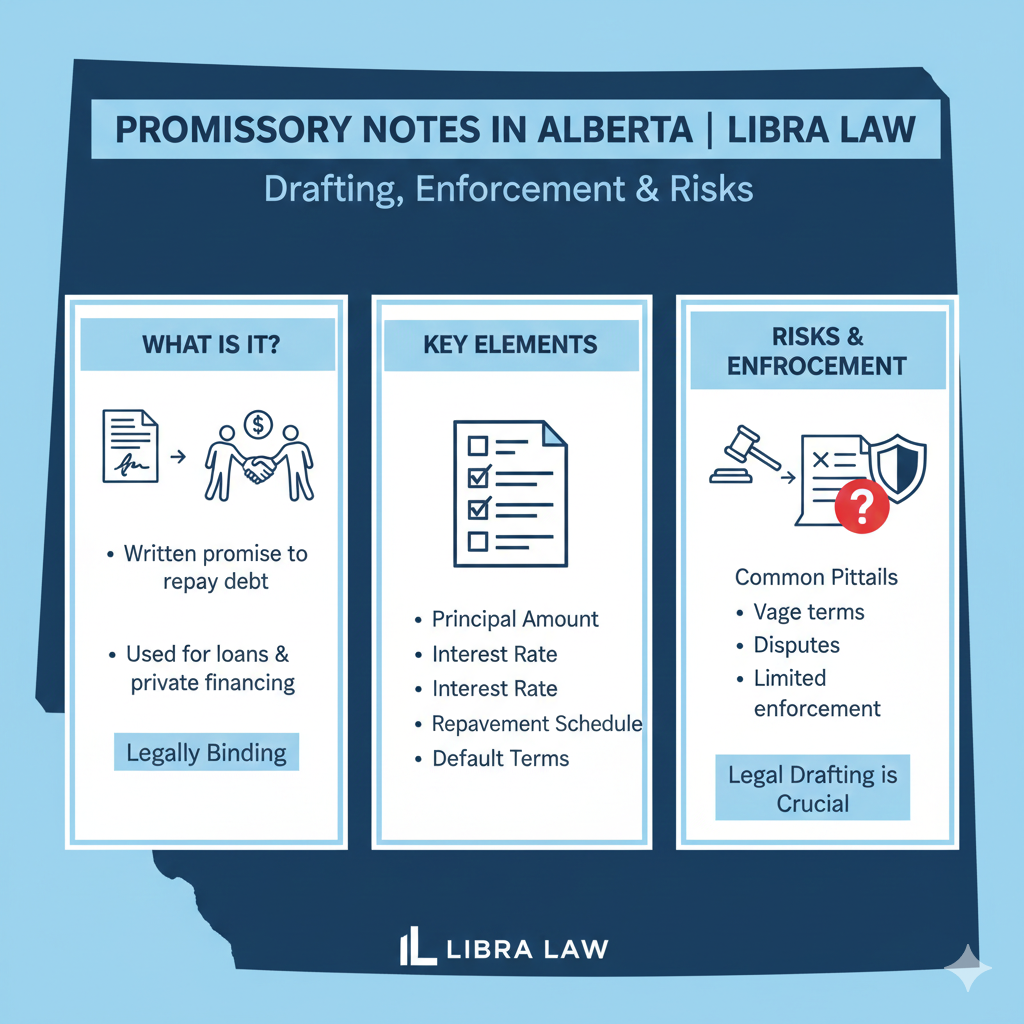
A promissory note is one of the shortest legal documents in common use and one of the most frequently botched. It can be a page long. It can also be worthless if the interest term is illegal, the limitation clock has run, or nobody can prove who owes what.
This guide from the Business Law team at Libra Law covers what a promissory note is, what it needs to be enforceable, and the practical differences between lending money and getting it back.
What a Promissory Note Is
A promissory note is an unconditional written promise, signed by the maker, to pay a specific sum of money either on demand or at a fixed or determinable future time. Promissory notes are governed by the federal Bills of Exchange Act.
The word “unconditional” is doing real work. If payment depends on something else happening, for example the borrower’s business becoming profitable, the document may not qualify as a promissory note at all. It might still be an enforceable contract, but it loses the procedural simplicity that makes notes attractive.
Promissory Note, Loan Agreement, or IOU?
- An IOU acknowledges a debt. It often does not promise to pay, on any particular date, in any particular amount.
- A promissory note is a clean, self-contained promise to pay. Best for straightforward loans where the terms are simple.
- A loan agreement is a longer contract with covenants, conditions, events of default, reporting, and security. Better for larger or commercial lending.
Choosing a note when you needed a loan agreement is common. If the loan involves security over assets, staged advances, or ongoing conditions, a note alone is the wrong instrument.
What Belongs in the Note
At minimum:
- Parties. Full legal names. For corporate borrowers, the exact registered name and the signing authority of whoever signs. A note signed by a director personally is a different obligation than one signed on behalf of the corporation.
- Principal amount, in words and figures.
- Interest rate, expressed clearly, and stated as an annual rate.
- Payment terms. On demand, in instalments with dates and amounts, or a single maturity date.
- Default provisions. What counts as default, whether the full balance accelerates, and what happens to interest after default.
- Place of payment and governing law. Alberta.
- Date and signature.
Optional but often valuable: prepayment rights, a costs of collection clause, and a witness. A witnessed or notarized signature does not make an otherwise invalid note valid, but it removes an easy line of defence about whether the borrower actually signed. Our Notarial Services team can attend to execution.
Demand Notes vs. Term Notes
This is the single most consequential drafting choice.
A demand note is payable when the lender demands payment. It offers flexibility, which is why family and shareholder loans so often use it.
A term note is payable on a set date or schedule. It offers certainty and a clear default trigger.
The choice affects when your limitation clock starts, which is covered below, and it affects how the loan is treated commercially. A demand note that is never demanded can sit dormant for years and then run into an argument about whether the right to sue expired long ago.
Interest: Get This Right or Lose It
Two rules matter.
First, if you want interest, say so in the note. A silent note is an interest-free loan. Courts will not write a rate in for you, although statutory prejudgment interest may apply once you are in litigation.
Second, there is a criminal ceiling on interest. The Criminal Code prohibits entering into an agreement or arrangement to receive interest at a criminal rate. As of 1 January 2025, that rate is 35% annual percentage rate. The calculation captures more than the stated rate; fees, bonuses, and other charges tied to the credit advanced can count as interest. Short-term loans with flat fees are the usual offenders, because a “small” fee on a 60-day loan can annualize far past the ceiling.
We cover this in detail in our article on the criminal interest rate in Canada.
Security: The Difference Between a Promise and a Remedy
An unsecured promissory note gives you a right to sue. It does not give you a claim on any particular asset, and it puts you behind every secured creditor if the borrower fails.
If the amount matters, consider:
- A general security agreement over the borrower’s personal property, registered at the Personal Property Registry. See general security agreements in Alberta explained.
- A mortgage or caveat against real property.
- A personal guarantee from a director or shareholder where the borrower is a corporation. Guarantees carry their own risks for the person signing. See personal guarantee in Alberta.
A note plus registered security is a materially stronger position than a note alone, and the incremental legal cost is small relative to the exposure.
Limitation Periods: The Deadline That Kills Most Claims
Alberta’s Limitations Act generally requires a claim to be brought within 2 years of when the claimant first knew, or ought to have known, that the injury occurred and that a proceeding was warranted. There is also a 10-year ultimate limitation period.
Applied to notes:
- Term note. The clock generally starts on the missed payment or the maturity date.
- Demand note. The clock generally starts when demand is made and not met. This is why demand notes can survive longer, and why a lender who never demands may face an argument that the right of action arose much earlier.
- Instalment note. Each missed instalment can start its own clock, which means part of a debt can be statute-barred while the rest is live.
Partial payments or a written acknowledgement of the debt can affect the analysis. If you have an old note, get advice before you assume it is dead or assume it is alive.
Collecting on a Note
The usual sequence:
- Demand. For a demand note, this is a legal prerequisite, not a courtesy. A properly drafted demand letter also resolves a meaningful share of defaults without litigation. See demand letters in Alberta and the value of legal representation.
- Claim. Civil claims up to $100,000 can be filed in the Alberta Court of Justice. Larger claims go to the Court of King’s Bench.
- Judgment. A promissory note is often a strong candidate for summary judgment, because the obligation is written, liquidated, and unconditional. That is the procedural advantage of using a note properly.
- Enforcement. A judgment is not money. Collection under Alberta’s civil enforcement framework can include registering a writ, garnishment, and seizure. A judgment against a borrower with no assets is a paper victory.
Common Pitfalls
- The family loan with no paperwork. Then a relationship changes, or someone dies, and the estate has to decide whether it was a loan or a gift. A one-page note prevents years of conflict.
- The shareholder loan recorded only in the accounting records. Bookkeeping entries are not an enforceable promise to pay. If your corporation is lending to or borrowing from its shareholders, document it. See the importance of maintaining corporate records in Alberta.
- The corporate borrower with no guarantee. If the company is thin, the note is only as good as the company.
- An interest term that annualizes past the criminal rate.
- No governing law or place of payment, which complicates enforcement against an out-of-province borrower.
- Amending by handshake. Extensions, deferrals, and forgiveness should be in writing and signed. Verbal variations invite disputes about what was agreed.
Related Reading
- Legally Binding Contracts in Alberta: Key Principles for Business
- The Criminal Interest Rate in Canada
- General Security Agreements (GSA) in Alberta Explained
- More resources in our Articles section
Final Thoughts
A promissory note is a powerful, inexpensive instrument when it is drafted with the same care as the loan it documents. Name the parties precisely, state the interest lawfully, decide deliberately between demand and term, take security if the amount justifies it, and watch the limitation period.
Whether you are lending or borrowing, talk to a business lawyer at Libra Law before the money moves.
This article is for general informational purposes only and does not constitute legal advice. For advice specific to your situation, consult a qualified professional.
