Termination Pay for Short-Term Employees in Alberta
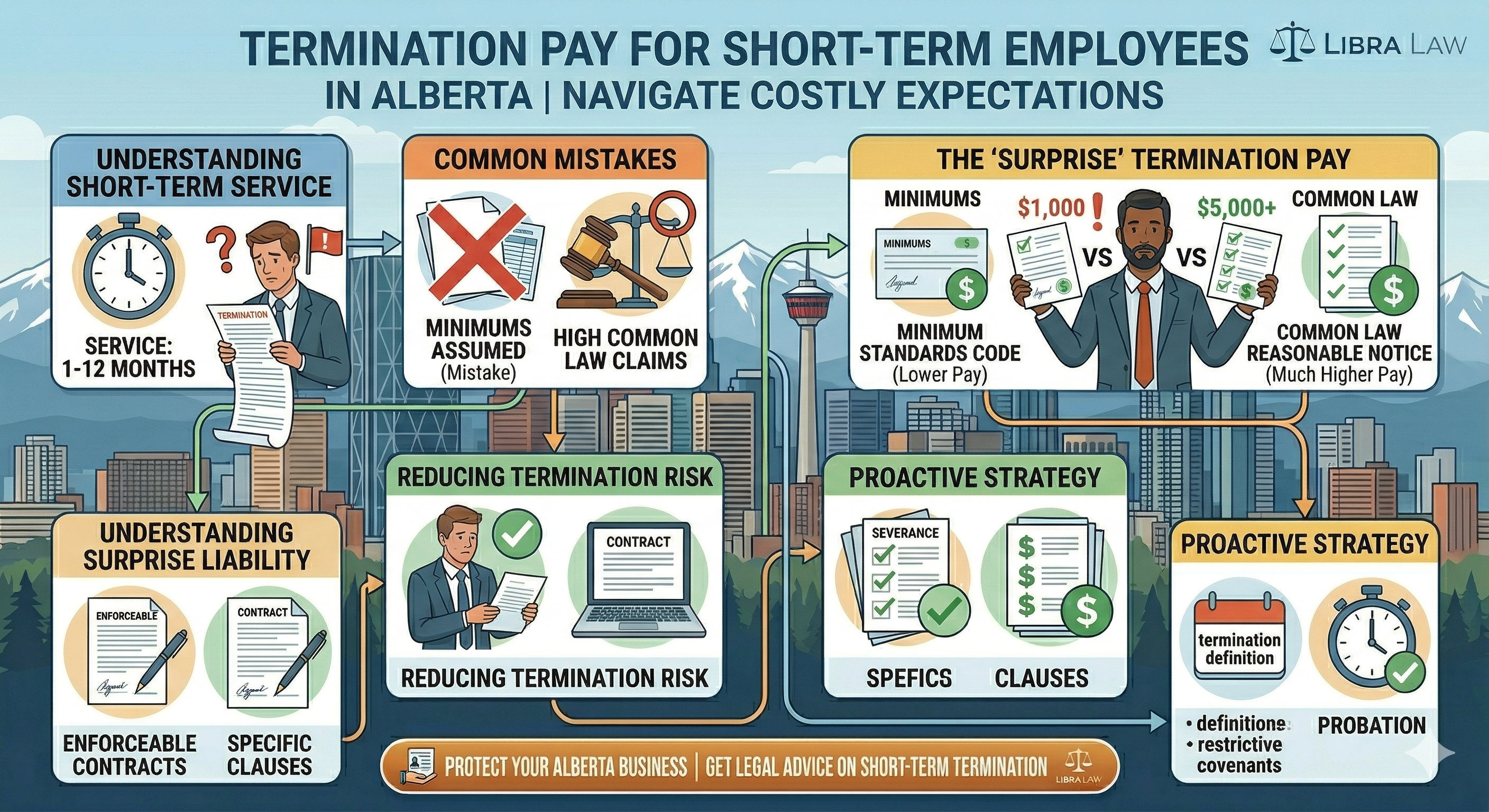
Many Alberta employers assume that if an employee has only worked for the business for a short time, the legal risk on termination must also be low.
That assumption can be expensive.
Short-term employees are often treated as though they have little leverage and minimal entitlement. But in practice, termination pay for short-term employees in Alberta can be much higher than employers expect, especially when the employment contract is weak, outdated, unclear, or missing altogether.
This is one of the most common mistakes Alberta employers make when handling dismissals. A short-service employee may still have a meaningful claim, and the employer who relies on guesswork instead of legal review may create unnecessary liability.
If your business is planning a termination, reviewing the employment contract and the broader legal context before taking action is essential.
Why employers underestimate termination pay for short-term employees
Many employers focus only on the employee’s length of service. That is understandable, but it is often too narrow an approach.
Short-service employees can still create real legal exposure because the analysis does not always begin and end with the bare minimum standards. A business may assume that someone who has worked for only a few months or a year will receive very little, only to discover that the actual risk is higher than expected.
This usually happens when:
- there is no written employment contract
- the termination clause is poorly drafted
- the contract is outdated or inconsistent
- the employee was recruited away from another role
- compensation includes bonuses, commissions, or benefits
- the employer mishandles the termination process
If your business has not reviewed its termination practices recently, you may also want to read costly employment mistakes Alberta employers should avoid.
Minimum termination standards are only part of the picture
One of the biggest mistakes employers make is assuming that minimum termination standards always reflect the full scope of their risk.
They do not.
At a minimum, Alberta employers need to understand the province’s employment standards rules around termination notice and termination pay. But that is only one part of the analysis. The wording of the employment contract, the employee’s role, compensation structure, and the way the termination is handled can all affect the employer’s position.
That is why it is risky to assume a short-term employee automatically has only a minimal claim.
For a broader discussion of employer obligations, see Alberta Employment Standards Code employer obligations and common mistakes.
Why written employment contracts matter so much in short-service terminations
When an employer terminates a short-term employee, one of the first questions is whether there is a strong written employment contract in place.
A properly drafted contract can help define expectations and reduce uncertainty. A weak or generic contract can do the opposite.
This is particularly important when dealing with:
- termination provisions
- bonus or commission language
- probation clauses
- confidentiality obligations
- workplace policy incorporation
- role-specific restrictions
If the business is relying on a vague offer letter, an old template, or a contract copied from another source, that can create serious problems when termination happens.
For more on this issue, read:
- written employment contracts in Alberta and how they protect your business
- employment contract clauses that protect employers in Alberta
- whether post-hire employment contracts are enforceable in Alberta
Common reasons short-term employees may have higher-than-expected claims
There is no single reason why a short-term termination claim may be larger than expected. Often, it is a combination of factors.
1. No contract or a weak termination clause
If there is no written contract, the employer loses one of its main tools for creating clarity around the relationship.
Even if there is a written agreement, the termination language may be poorly drafted, vague, inconsistent, or outdated. In that case, the employer may not get the certainty it expected as the employee may be entitled to a longer termination notice under common law.
This is one of the biggest reasons a short-term employee can have more leverage than the employer assumed.
2. The employee was recruited away from another opportunity
A short-service employee may still have a strong argument that the job change carried meaningful risk for them. If they left another position or gave up a more stable opportunity to join your business, that context can matter in how the situation is viewed overall.
Employers often overlook this when they focus only on the number of months the person worked.
3. The employee holds a specialized or senior role
A short-service employee in a specialized, management, client-facing, or senior role may not be in the same position as a more junior employee when it comes to replacement opportunities.
This is another reason employers should avoid one-size-fits-all assumptions about termination pay.
4. Compensation is more complex than salary alone
Termination risk is not always limited to base pay.
If the employee receives:
- bonuses
- commissions
- car allowances
- benefits
- other incentives or variable compensation
then the termination analysis may become more complicated. Employers sometimes overlook these items when calculating exposure, especially if the contract does not address them clearly.
For related reading, see severance packages in Alberta and wrongful dismissal compensation in Alberta.
5. The termination is handled poorly
Even when the legal position is manageable, the way a termination is handled can make matters worse.
Common mistakes include:
- terminating without reviewing the contract first
- using a rushed or poorly drafted termination letter
- making inconsistent statements about the reason for termination
- ignoring bonus, commission, or benefit issues
- offering a package without legal review
- assuming probation automatically solves everything
A poorly handled dismissal can increase conflict and make settlement more difficult.
If your business is preparing a dismissal, this related resource may help: lawyer review of a termination letter in Alberta.
Does probation eliminate termination risk?
Many employers assume that if an employee is on probation, there is little or no risk in ending the relationship.
That is too simplistic.
Probation language still needs to be reviewed carefully. Employers should not assume that simply labeling someone “probationary” answers every legal question. The wording of the contract, the timing, the circumstances, and the broader employment relationship still matter.
This is one reason why businesses should not rely on informal assumptions about probation clauses.
Why Alberta employers should avoid “short service = small claim” thinking
This is one of the most dangerous assumptions in employment law.
A short-service employee may still create significant legal exposure if:
- the contract is weak
- the termination clause is ineffective
- the employee has strong compensation arguments
- the role is specialized
- the person was actively recruited
- the dismissal process is mishandled
The employer that assumes the claim must be small may underinvest in the review process, use the wrong letter, offer the wrong package, or take a harder position than the facts justify.
That often leads to a more expensive dispute.
For more employer-side guidance, see severance pay in Alberta.
How Alberta employers can reduce termination risk
A business does not need to wait until a dispute happens to improve its position.
A practical risk-reduction approach includes:
- using properly drafted written employment contracts
- reviewing termination clauses regularly
- making sure bonus and commission language is clear
- documenting performance and workplace issues consistently
- reviewing the employee’s full compensation structure before termination
- obtaining legal advice before issuing a termination letter
- avoiding generic templates and rushed decisions
If your business is still relying on informal or outdated documents, now is the time to address that.
You may also want to review written contracts for small business in Alberta.
When legal review is especially important
Legal advice is especially important when:
- the employee has a short but important tenure
- the role is senior, specialized, or revenue-generating
- the compensation structure includes bonuses or commissions
- the contract language is old or unclear
- the employee was hired away from another role
- the business wants to terminate during or near probation
- the employer is unsure how to structure the package
A short review before termination is often far less expensive than dealing with a claim afterward.
For practical support, visit Libra Law’s employment law services.
Final thoughts
Termination pay for short-term employees in Alberta is often higher than employers expect because length of service is only one part of the risk analysis.
If the employment contract is weak, the compensation structure is complex, or the termination is handled poorly, even a short-service employee may have a more significant claim than the employer assumed.
That is why Alberta employers should avoid relying on shortcuts or generic assumptions. A careful review of the contract, the role, and the termination process can help reduce risk before the situation becomes more costly.
If your business needs guidance before terminating an employee, visit Libra Law’s employment law services or contact Libra Law.
FAQ: Termination pay for short-term employees in Alberta
Can a short-term employee still receive meaningful termination pay in Alberta?
Yes. Employers often assume short-service employees have very limited claims, but that is not always the case. The contract, role, compensation structure, and overall circumstances can all matter.
Does probation prevent a termination claim?
Not automatically. A probation clause does not eliminate risk on its own. The wording of the agreement and the surrounding circumstances still matter.
Why does the employment contract matter so much in a short-service termination?
Because the contract may shape the employer’s position on termination, compensation, and related issues. If the contract is weak or outdated, the employer may face more uncertainty and greater risk.
When should an Alberta employer get legal advice before termination?
Ideally before any termination letter or package is delivered, especially if the employee has a complex compensation structure, the contract is unclear, or the employer is relying on probation or short service as the main reason for assuming risk is low.
This article is for general informational purposes only and does not constitute legal advice. For advice specific to your situation, consult a qualified professional.
