Written Employment Contracts in Alberta for Employers
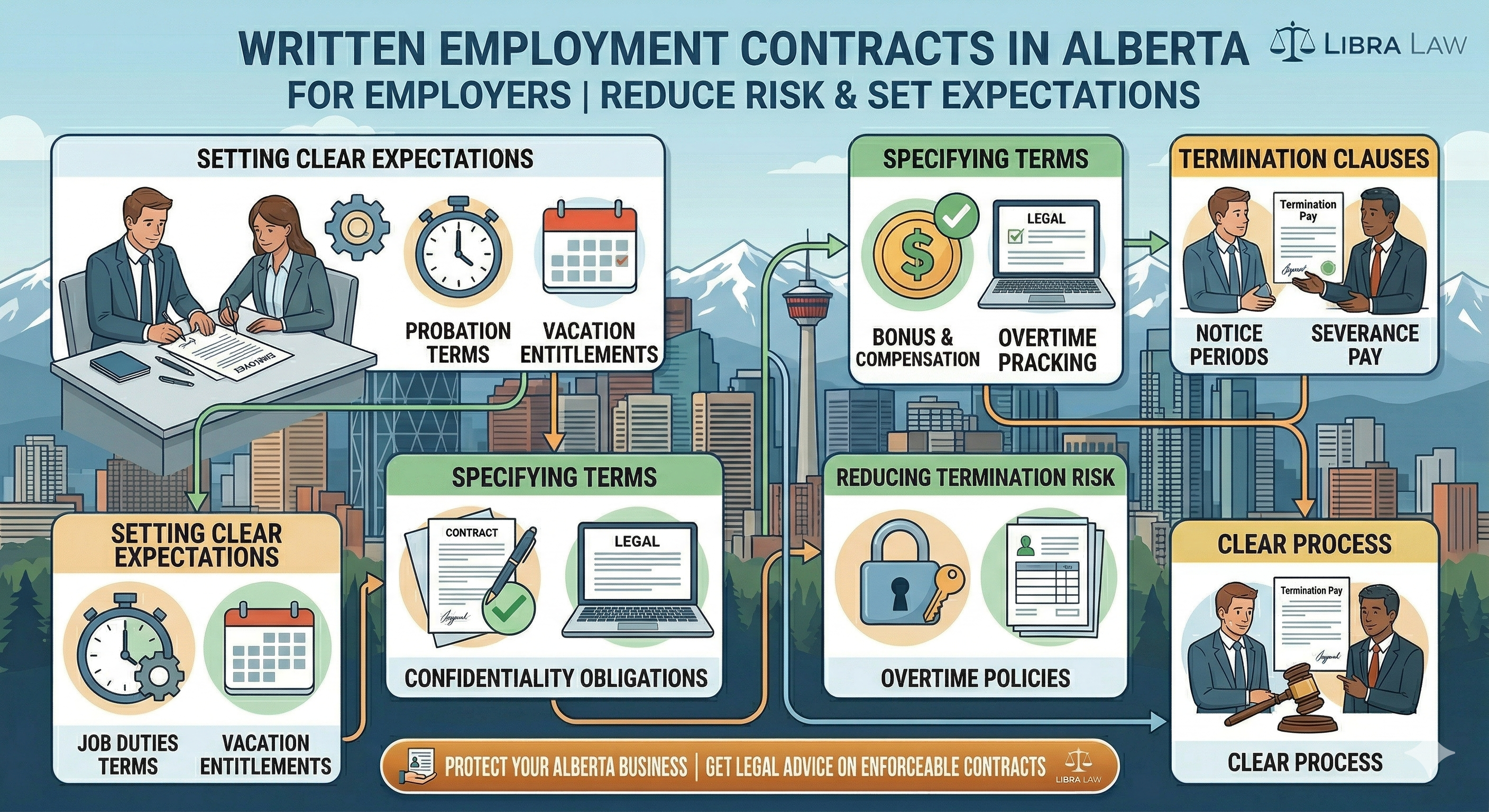
If you are hiring employees in Alberta, one of the most important steps you can take to protect your business is using a properly drafted written employment contract.
Many employers still rely on verbal agreements, short offer letters, or outdated templates. That may seem faster in the moment, but it can create expensive problems later. Disputes over compensation, duties, bonus eligibility, termination, confidentiality, and restrictive covenants often become much harder to manage when the employment relationship is not clearly documented.
In Alberta, the Employment Standards Code sets minimum standards for issues such as wages, hours of work, overtime, vacation and holidays, leaves, and termination of employment. Those minimum standards cannot simply be avoided through contract language, which makes careful drafting especially important.
A strong written employment contract helps Alberta employers reduce ambiguity, manage expectations, and lower legal risk from the start.
Why written employment contracts matter in Alberta
A written employment contract gives both the employer and the employee clarity about the terms of the relationship. Without that clarity, small misunderstandings can turn into much larger disputes.
Employers often run into problems when:
- duties are never clearly defined
- compensation terms are vague
- bonus language is incomplete
- termination clauses are poorly drafted
- confidentiality expectations are not spelled out
- workplace policies are not incorporated properly
The contract is not just paperwork. It is one of the main legal tools you have to protect your business.
If you want a broader overview of where employers often go wrong, read costly employment mistakes Alberta employers should avoid.
What a written employment contract can do for your business
A well-drafted employment agreement can help your business:
- clearly define the employee’s role
- set compensation and bonus expectations
- reduce disputes over policies and workplace obligations
- address confidentiality and intellectual property issues
- create more certainty around termination
- support consistent onboarding and management practices
This is particularly important for growing businesses. As your workforce expands, informal arrangements become harder to manage and more likely to create risk.
For businesses that are still building their internal systems, this related resource is useful: small business legal checklist for Calgary entrepreneurs.
Key terms Alberta employers should include in a written employment contract
A written employment contract in Alberta should be tailored to the role and the business. Not every contract needs the same clauses, but there are several terms employers should consider carefully.
1. Job title, duties, and reporting structure
The contract should describe the employee’s position, main responsibilities, and who they report to. This helps reduce confusion and can be useful if the business changes later or performance issues arise.
Unclear job descriptions can lead to disputes about whether an employee was expected to perform certain tasks or whether a later change was reasonable.
2. Compensation and bonus terms
The contract should set out:
- base salary or hourly wage
- how and when pay is provided
- whether bonuses are discretionary or guaranteed
- commission terms, if applicable
- any benefit eligibility
Compensation disputes are common when bonus or commission language is too vague. If your business uses incentives, those provisions should be drafted with care.
3. Hours of work and scheduling expectations
Alberta employers should be clear about expected work hours, scheduling, and whether any averaging or overtime-related practices may apply. Alberta’s official employer toolkit continues to provide updated guidance on hours of work, overtime, and related employer responsibilities, which shows how important it is to get these basics right.
A contract cannot override Alberta’s minimum employment standards, but it can still help define expectations and reduce ambiguity.
4. Vacation and leave-related terms
Your contract should also address vacation entitlements and how employees request time off. Alberta’s minimum employment standards include rules on vacation, general holidays, and protected leaves, and employers should ensure their contracts and policies are aligned with those standards.
This is an area where outdated templates often cause trouble, especially when a business has grown or changed its internal practices.
5. Confidentiality and protection of business information
If your employees have access to confidential information, customer data, internal systems, pricing, marketing plans, or trade knowledge, the contract should address confidentiality clearly.
This is one of the easiest issues to overlook when onboarding employees informally. By the time an employee leaves with sensitive information or client knowledge, it may be too late to fix the contract problem.
6. Intellectual property terms
For certain roles, especially in technical, creative, operational, or strategic positions, employers should think carefully about intellectual property ownership. If an employee creates work product, systems, content, designs, or internal materials, the agreement should make the business’s expectations clear.
7. Restrictive covenants where appropriate
Depending on the role, a business may want to consider non-solicitation, non-competition, or other post-employment restrictions. These clauses should never be copied casually from a template. They should be role-specific and drafted as narrowly and carefully as the law requires.
For more on this issue, read non-compete clauses in Alberta.
8. Termination provisions
Termination language is one of the most important parts of a written employment contract. It is also one of the areas most likely to create problems when handled poorly.
Alberta’s current Employment Standards Code sets minimum standards for termination, and Alberta’s employer guidance continues to provide detailed information on termination of employment and temporary layoff.
A properly drafted contract may help create more certainty, but weak or outdated termination language can increase risk instead of reducing it.
For related guidance, see:
- severance pay in Alberta
- severance packages in Alberta
- wrongful dismissal compensation in Alberta
- lawyer review of a termination letter in Alberta
Why Alberta employers should not rely on generic contract templates
Many employers assume a template contract is good enough as long as it covers the basics. That is risky.
Generic templates often:
- do not reflect Alberta-specific rules
- use vague or inconsistent language
- fail to match the actual role
- contain overly broad restrictive covenants
- use weak termination provisions
- ignore how bonuses, commissions, or benefits really work in the business
A contract should match the role, the compensation structure, and the business’s actual risk profile.
If you are dealing with old forms or documents added after hiring, read whether post-hire employment contracts are enforceable in Alberta.
Why timing matters when using written employment contracts
The best time to put a strong employment contract in place is before the employee starts work.
Many Alberta employers wait too long. They hire quickly, use a basic offer letter, and only think about stronger protection later when a problem appears. That can make it harder to introduce new terms cleanly and effectively.
If you want protection around termination, confidentiality, intellectual property, or restrictive clauses, it is far better to handle that at the start of the employment relationship.
For a more detailed look at useful provisions, read employment contract clauses that protect employers in Alberta.
How written contracts help reduce costly employment disputes
A written employment contract does not prevent every workplace dispute, but it can reduce many common areas of conflict.
For example, a strong agreement can help reduce disputes about:
- compensation expectations
- bonus or commission entitlement
- job duties
- policy compliance
- confidentiality obligations
- termination structure
- post-employment conduct
Without a written agreement, employers are often left trying to prove what was said, what was intended, and what the parties actually agreed to.
That kind of uncertainty is expensive.
You can also explore Libra Law’s employment law services in Alberta if your business needs practical help with contract review or drafting.
Written contracts are especially important for growing businesses
The more your business grows, the more important consistent documentation becomes.
Written employment contracts are especially useful when your business:
- hires multiple employees
- uses commission or bonus structures
- has customer-facing staff
- handles confidential information
- is preparing for expansion or sale
- is hiring foreign workers
- is restructuring roles or management
Employment issues often overlap with broader business decisions. If your company is growing, buying another business, or hiring workers through immigration pathways, strong contracts become even more important.
Related reading includes:
- buying a business and employment law risks in Alberta
- buying a business that employs foreign workers
- employer-sponsored work permits in Canada
- business law services in Alberta
Final thoughts
Written employment contracts are one of the most practical ways Alberta employers can protect their business. They create clarity, support compliance, reduce disputes, and help employers manage risk from the very beginning of the employment relationship.
Relying on verbal arrangements or generic templates may seem easier in the short term, but it often creates avoidable problems later. A properly drafted contract tailored to your business and your employees is usually a far better investment.
If your business needs help drafting or reviewing written employment contracts, visit Libra Law’s employment law services or contact Libra Law.
FAQ: Written employment contracts in Alberta
Do Alberta employers need written employment contracts?
A written employment contract is not required for every job, but it is one of the best ways to reduce legal risk, clarify expectations, and protect the business if disputes arise.
Can a written employment contract override Alberta employment standards?
No. Alberta’s Employment Standards Code sets minimum standards, and employers generally cannot contract out of those minimum requirements.
What should be included in an Alberta employment contract?
That depends on the role, but common terms include duties, compensation, bonus language, hours of work, vacation, confidentiality, intellectual property, restrictive covenants, and termination provisions.
Why should Alberta employers avoid generic employment contract templates?
Because generic templates often do not reflect Alberta law, the actual role, or the business’s real risk areas. Poor drafting can create more problems instead of preventing them.
This article is for general informational purposes only and does not constitute legal advice. For advice specific to your situation, consult a qualified professional.
